

TechnologyDEVELOPING
India Targets 1 Lakh More Semiconductor Engineers Under Semicon 2.0
Government Plans Major Expansion of Chip-Design Talent as India Builds Its Semiconductor Ecosystem
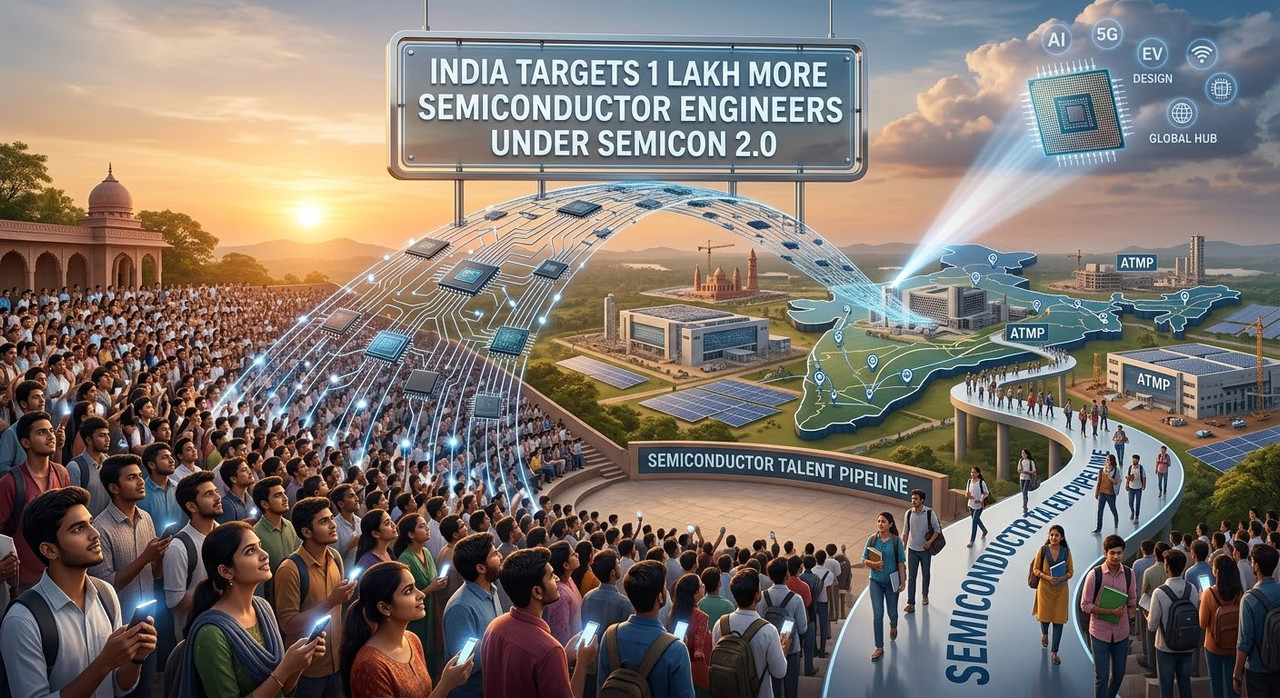
New Delhi, August 31, 2026 : India is preparing for a major expansion of its semiconductor talent pool, with the government targeting the training and development of around one lakh additional semiconductor engineers under the next phase of its semiconductor programme, Semicon 2.0.
Union Electronics and Information Technology Minister Ashwini Vaishnaw said the government is focusing not only on building semiconductor manufacturing capacity but also on developing the specialised workforce required to design and manufacture advanced chips.
The move comes as semiconductors become increasingly important to almost every major technology sector, from smartphones and electric vehicles to artificial intelligence, telecommunications, defence systems and data centres.
Building talent alongside chip infrastructure
India has been investing heavily in establishing a domestic semiconductor ecosystem. New manufacturing and packaging facilities are expected to create demand for engineers and specialists with expertise in chip design, fabrication, testing, packaging and related technologies.
The government’s latest talent target reflects a recognition that physical infrastructure alone will not be enough to make India a major global semiconductor hub.
Advanced chip manufacturing requires highly specialised skills across multiple disciplines, including electronics engineering, materials science, computer engineering and semiconductor process technology.
AI is increasing demand for advanced chips
The semiconductor push also comes at a time when artificial intelligence is driving enormous demand for high-performance computing infrastructure.
AI models require increasingly powerful processors, memory technologies and specialised accelerators. As India expands its AI capabilities, the availability of domestic semiconductor expertise could become strategically important.
The government’s semiconductor strategy therefore has implications well beyond the electronics industry. A stronger domestic chip ecosystem could support India's ambitions in AI, cloud computing, telecommunications, automotive technology and defence.
Opportunity for India's technology workforce
For Indian engineering students and technology professionals, the expansion could create new career opportunities in one of the world's most strategically important technology industries.
Universities, engineering institutions and technology companies are likely to play an important role in developing the specialised skills required by the industry. Closer cooperation between academia and semiconductor companies could help ensure that training programmes reflect the needs of rapidly evolving chip technologies.
India already has a large pool of engineers working in software and information technology. The semiconductor initiative represents an opportunity to expand that strength into hardware, chip design and advanced electronics.
A long-term technology strategy
The semiconductor programme is part of India's broader effort to strengthen domestic technology capabilities and reduce dependence on overseas supply chains.
While building a competitive semiconductor industry will take years, the government's emphasis on both infrastructure and skilled manpower indicates a long-term approach.
The success of the programme will ultimately depend on whether India can convert investment and training into commercially competitive chip-design and manufacturing capabilities.
With artificial intelligence, electric mobility and connected devices expected to drive semiconductor demand in the coming years, the race to develop both chips and the people capable of building them is becoming increasingly important.
For India, the next phase of the semiconductor journey may therefore be defined not only by factories and billions of rupees in investment, but also by the engineers who will design the technology powering the country's digital future.
Mohammed AUK
Senior Correspondent — MAUK News
The MAUK News Briefing
A concise daily digest of verified reporting, analysis and perspective. No noise.
Comments (0)
No comments yet. Start the conversation.